

Did Animals Really Freeze Instantly In Ice Age
Originally published in Journal of Creation 14, no 3 (Dec 2000): 24-34.
Mammoth remains accept puzzled scientists and laymen for hundreds of years.
Summary
Apart from formerly glaciated areas, woolly mammoth remains are arable in the surficial sediments of the mid and loftier latitudes of the Northern Hemisphere, including western Europe, northern and eastern asia, Alaska and the Yukon. In that location are probably millions of mammoths buried in the permafrost of Siberia lonely. The mammoths are found with a wide variety of other mammals, big and small, many of which were grazers. They lived in a grassland environment with a long growing flavor, mild winters, very petty permafrost, and a wide diverseness of plants—quite different from the climate in the region today.
The mammoths and other animals colonised the region later on the Flood during the ice age. The region's climate during the ice historic period was ideal for rapid population growth and, in the 600 or so years before their demise, the population had grown to many millions of animals. They were buried in the dust storms that deposited the loess blankets found in those regions today. Some were entombed in a standing position. The good state of preservation of the stomach contents does not phone call for super-rapid freezing of the carcasses. Rather than food digestion, the mammoth stomach acts every bit a food storage pouch. The mammoths became extinct when, at the stop of the ice age, the climate in the region became more than continental, with colder winters, warmer summers, and drier conditions.
Frozen carcasses and many thousands of tons of basic and tusks of woolly mammoths are cached in Siberia and Alaska. In March 2000, the Discovery Aqueduct produced a special on the earthworks of a carcass in north central Siberia, chosen the Jarkov mammoth. This mammoth was cut out of the permafrost and transported by helicopter into cold storage for time to come analysis and possible cloning.1
Mammoth remains take puzzled scientists and laymen for hundreds of years. Many explanations accept been offered. One of the near pop hypotheses is that one eventful day, the hairy elephants were peacefully grazing on grass and buttercups when all of a sudden, tragedy struck, and millions of them froze instantly.
This commodity examines the life and expiry of the woolly mammoth in Siberia, Alaska, and the Yukon Territory of Canada. These areas, together with the surrounding shallow ocean (Bering Strait), are called Beringia. There are still unknowns associated with the woolly mammoth and its environs in Beringia. Some information is conflicting. Yet, the information is pointing to a unique environment and extinction of the woolly mammoths in Beringia.
What is a woolly mammoth?
A woolly mammoth (Mammuthus primigenius) is ane of several types of mammoths in the genus Mammuthus within the gild Proboscidea. The woolly mammoth is essentially a hairy elephant with a large shoulder hump, a sloping back, pocket-sized ears, tiny tail, unique teeth, a small body with a distinctive tip and two finger-similar projections, huge spirally curved tusks upwards to 3.5 meters long, and spiral locks of dark hair roofing a silky underfur.2
Mammoths are classified mainly on variables such as tooth hypsodonty (height of the crown), number of lamellae (ridges on crown), and enamel thickness. History shows at that place has been much taxonomic splitting of mammoths, every bit well as other members of Proboscidea. Information technology is probable that they are all descended from a single created kind.ii In general, in that location seem to exist two chief varieties of mammoths on both Eurasia and North America. The woolly mammoth is the smaller variety that generally inhabited the north. The second, more southern diverseness, from both Eurasia and North America tin can be lumped together for simplification and referred to as the Columbian mammoth (Mammuthus columbi).
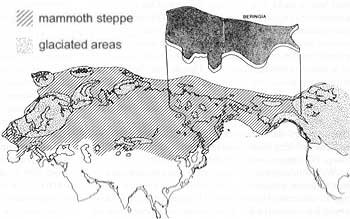
Effigy 2. Distribution of woolly mammoth remains, and the mammoth steppe. Glaciated areas are shown speckled. Mammoth steppe is shown hatched. The expanse referred to as Beringia is shown separately (after Guthrie143). Annotation that the extent of the northern and eastern boundaries of the Scandinavian ice sheet is controversial.
Mammoth distribution
Mammoths are normally plant in surficial sediments from western Europe eastward through northern and eastern Asia, Alaska and the Yukon (Figure ii).3,4 Mammoth remains are likewise plant on some of the islands in the Bering Sea5,half dozen and are dredged from the shallow continental shelves surrounding Beringia.7,8 Enormous numbers of water ice age mammals, virtually commonly mammoths, are dredged upward from the unconsolidated sediments of the North Sea by trawlers.9 Woolly mammoths are found in abundance south of the North American ice sheet. They are rare in formerly glaciated areas. Mammoth and mastodon teeth accept been dredged from 40 sites forth the continental shelf off the eastern U.s. in h2o upwards to 120 m deep.10
In Siberia, the woolly mammoth inhabited the whole area from the Ural Mountains to the Pacific Ocean. Their east-due west distribution is generally compatible, except that they are especially abundant in northeast Siberia.11 Their numbers increase farther north.12,13 Mammoth remains are amazingly abundant on the Lyakhov Islands14 and the other islands of the New Siberian Islands, 230 km north of the Arctic declension.12,xv Frozen mammoth carcasses are usually found eroding out of river banks and along the shore of the Arctic Ocean.
Mammoth brute
Woolly mammoths are not the just fossil mammals plant in the permafrost of Beringia. In that location are a broad range of other mammals, large and pocket-sized, that back-trail the mammoths. These include the woolly rhinoceros, wolf, fox, panthera leo, brown bear, camel, deer, ground sloth, pika, wolverine, ferret, ground squirrel, moose, reindeer, yak, musk ox, giant beaver, lemming, porcupine, coyote, skunk, mastodon, antelope, sheep, voles, hare and rabbit, plus many species of birds, rodents, horses, and bisons.4,16,17,18,19 Frozen carcasses of these animals, especially the woolly rhinoceros, are also institute. Generally, the same animals are constitute together throughout much of the mid and high latitudes of the Northern Hemisphere.iii,20
How many mammoths are buried in Siberia?
There has been much controversy over how many woolly mammoths are frozen in the permafrost of Siberia. A few scientists attempt to downplay the number,21 merely practically all observers describe the number in superlatives.
The top expert on woolly mammoths in Siberia, Nikolai Vereshchagin, has spent almost a half century of research on the mammoth animal. He states that there are many hundreds of thousands of large mammals cached in Siberia22 and likewise many millions of bones.23 Ane estimate he made for one region of Siberia would suggest v meg mammoths cached.24 Is he exaggerating? It would be conservative, therefore, to conclude that several million mammoths are buried in Beringia.
Perplexing mammoth data
In that location are many perplexing aspects to the Siberian mammoth finds, including the being of frozen carcasses and the good preservation of their tum contents. In improver, a number of the carcasses and skeletons have been unearthed in a general standing position, equally if the animate being sank in a bog.25,26,27 The Selerikhan horse was entombed in a general continuing position.28 The new Jarkov mammoth was dug upward in a standing position.
It is also relevant that an assay of several features of the carcasses shows that three woolly mammoths and two woolly rhinoceroses suffocated, including the Beresovka (or Beryosovka) mammoth29,30,31,32 The Beresovka mammoth also had a cleaved pelvis, ribs, and right foreleg13,27
For carcasses to be frozen and the bones and tusks well preserved, quick burial is necessary. Only how could all these woolly mammoths have been forced into the rock hard permafrost, which starts almost half a meter deep, below the summer melt zone?
Beringian paleoenvironmental deductions
The animals themselves tell us much nearly the paleoenvironment—a controversial subject.33 The diversity of animals was then slap-up that in that location must have been a highly various vegetation.34 The only like diversity of mammals is on the Serengeti of East Africa.34,35 Practically all the big mammals were grazers that ate a wide variety of herbaceous vegetation, mainly grasses. Based on the large numbers of healthy individuals, Beringia, as well as Europe and western Russia, must accept been by and large one huge grassland during the ice age, called the mammoth steppe or steppe tundra (Figure ii).3,34,36,37
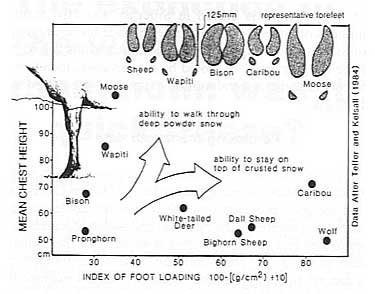
Figure iii. Ability of animals to walk through deep snow or to stay on top of crusted snowfall depends on human foot loading and chest pinnacle (afterwards Guthrie).144 The sheep and wolf could not have tolerated deep snowfall or boggy substrate.
To maintain a big diverseness of herbaceous vegetation on the mammoth steppe would have required a long growing season with warm soil and rapid spring growth.38 This contrasts strongly to the electric current environment where green vegetation does not appear in northern Siberia until mid June to early July.39 Xc pct of the biomass of grass is in the roots below the surface, and the grass cannot abound until the snow melts and the soil warms up. Therefore, winters must have been milder with light snowfall. The growth design of the mammals reinforces the deduction of a longer growing flavour.34 The shaggy ruffs, heavy horns, long tusks, and enormous antlers are what wild animals managers would recognise every bit indicators of high-quality habitat with lite competition and a long growing flavour.40 Open range with lite snow during wintertime is too supported by the existence of several animals that are intolerant of deep snow, such as the saiga antelope, bighorn sheep, Dall sheep, and wolf (Figure three).41
With milder winters and a longer growing season over an all-encompassing grassland, it is likely that there were no significant areas of permafrost. This is considering permafrost would have caused a boggy substrate in summer, making it difficult for much grass to abound. Further paleoecological evidence for a lack of permafrost comes from the being of some animals with pocket-sized hooves, such as the saiga antelope. This animal cannot manage on boggy substrate. Furthermore, there is plenty of other prove that the climate of Siberia was one time much warmer, but once more this show is somewhat obscured by uniformitarian dating and pigeonholing the evidence into supposed 'interglacial' and 'interstadial' periods.42
Mammoth uniformitarian problems
How millions of mammoths became entombed in Siberian permafrost really taxes the uniformitarian principle. Why would multitudes of mammoths, plus the many other animals, fifty-fifty want to alive in Siberia with its fierce winters and summer bogs? What would these large beasts eat? Siberia today supports but a very few large animals, and these are especially adapted to boggy vegetation and often migrate to escape the full strength of winter. Most perplexing of all, how did the woolly mammoths die in Siberia? Was it a quick freeze? Was man the hunter responsible for the demise of the mammoths?
Today, Siberia is well known for its bitterly common cold winters. The lowest temperature in the Northern Hemisphere is -68°C at Verkhoyansk.43 Large mammals tin usually tolerate a fair amount of common cold. But could the mammoths, horses, bison, and other animals tolerate 6 to nine months of biting cold with fifty-fifty colder wind-chill temperatures in blizzards? Vereshchagin and Baryshnikov44 state: 'There would be no place for mammoths in the present chill tundra of Eurasia with its dumbo snow driven past the winds.'
Could the animals take lived in Siberia today during the relatively warm summer, perhaps migrating in that location from the south? The temperature likely would have been pleasant for them, but the environment deadly. Siberia today is in the permafrost zone where upwards to a metre of the surface melts in the summer. H2o pools on the surface forming massive bogs and muskegs, making summer travel difficult, if not impossible, for human and beast.44,45 Tolmachoff46 states that a few inches of this sticky mud makes the substrate practically impassable for a human being, and that a pes or more than would probably trap a mammoth.
Siberia may exist lush with vegetation in the summertime, just information technology is the incorrect type. Although there are patches of grass, bog and muskeg vegetation predominates, and these are low in nutrition for grazers.47 The taiga forest vegetation south of the current tundra is also poorly digestible for grazers.48 Comparing living elephants to mammoths, the daily requirement for a woolly mammoth would have been about 200 to 300 kg of succulent vegetation49 and 130–190 litres of water! Vereshchagin50 flatly declares: 'Neither mammoth nor bison could exist in the sort of tundra that exists there [in Siberia] today.'
The problem is even more paradoxical in a uniformitarian ice age climate. Ice age climate simulations are of variable quality, depending upon the initial conditions, the approximations employed for circuitous variables, the particular physics, the number of variables, whether the simulation is a general apportionment model, etc. Nevertheless, the better full general circulation models demonstrate that the glacial climate of Siberia (assuming uniformitarianism) would have been colder (about 10–twenty°C) than today: 'During glacial and stadial stages, the climate of Siberia was much colder than at present.' 51 This deepens the mystery of why the lowlands of Siberia and Alaska were never glaciated!
Except possibly on Wrangel Island in the Arctic Sea,52,53,54 the woolly mammoth died out in Siberia at the end of the water ice age. Furthermore, the woolly mammoth and many of the other large mammals, including 33 genera from North America, disappeared on whole continents or went extinct. There are two chief hypotheses to account for all this extinction at the end of the ice age: either they were killed by man in a nifty blitzkrieg slaughter, or they died considering of climate change.55 Uniformitarian scientists practice not know the answer to this, simply it has been extraordinarily controversial for more than than 200 years. At a recent mammoth conference, Alroy expressed his frustration:
'Later on many decades of debate, the North American end-Pleistocene megafaunal mass extinction remains a lightning rod of controversy. The extraordinarily divergent opinions expressed in this volume show that no resolution is in sight.' 56
Non-creationist hypotheses
Such confounding enigmas, not merely well-nigh the mammoth and the mammoth steppe fauna, but also most the ice age itself, accept naturally produced many hypotheses. Early scientists produced a lot of confused writing. For case, Sir Henry Howorth,7,12 who gathered copious observations from Siberian explorers that are considered adequately accurate, believed the mammoths met their demise in a continental-scale flood, merely that this flood was not Noah's Overflowing.
Immanuel Velikovsky wrote two influential popular books on astral and earth catastrophes, called Worlds in Collision57 and Earth in Upheaval.58 In these books the demise of the woolly mammoths in Siberia played a lead role. He weaved the mysteries of the mammoth, the ice historic period, and many other puzzles from the earth sciences into a catastrophic adventure featuring Venus and Mars, occurring about 3,500 years ago. Velikovsky is precipitous at pointing out the many globe science puzzles of the past, which a large number of scientists seem to either ignore or minimise. However, he cannot help merely add an element of hyperbole, such equally the following in referring to the 'muck' of Alaska:
'Under what weather condition did this great slaughter have place, in which millions upon millions of animals were torn limb from limb and mingled with uprooted trees?' 59
His mechanism for explaining the extinction of the woolly mammoth, supposedly living in a warm climate and then suddenly existence quick frozen, is a catastrophic poleshift to a more than vertical Globe axis (to warm the region up) so back again to near the nowadays 23½ degrees (to absurd information technology down). The thought of a quick freeze is based mainly on the presence of nutrient in the mammoths' mouths and not plenty time for their last meals to decay in their stomachs. Other popular writers have accepted and embellished Velikovsky's ideas.60,61,62
Charles Ginenthal63 provides an updated, more elaborate defense of Velikovsky's pole shift hypothesis. There is one major trouble, among many, with Ginenthal's and Velikovsky's hypothesis, and that is a pole shift to a more vertical centrality will cool the region, not warm it up.
Creationist hypotheses
The information on the woolly mammoths in Siberia is confusing, and almost of it is published in Russian. All this data, and the many hypotheses, were bound to influence creationists, who also accept been attempting to translate the evidence in a catastrophic framework related to the Inundation. Harold Clark64 recognised that the extinction of the mammoths in Siberia was a major puzzle that needed a creationist explanation: 'One of the nearly perplexing phenomena of geology is that of the and so-called "frozen mammoths" of Siberia.'
Many creationists accept leaned towards a Flood demise.65,66,67,68 Joseph Dillow,69 who wrote an in-depth book on the vapour canopy, focussed considerable attention on how the woolly mammoth became extinct.70 He proposed that the hairy beasts were quick-frozen just before the Flood. Walter Brown32 included a chapter in his hydroplate model on what happened to the woolly mammoths. He proposed that the woolly mammoths died during the Flood by a quick freeze. Dillow and Brown fabricated several mistaken deductions on the data related to the woolly mammoth and its environment in Beringia, such as that at that place is over i,200 one thousand of 'muck' containing animal and vegetative remains.71,72
Clark64, Harold Bury,73 and myself 74 believe that the woolly mammoth lived and died during the ice historic period after the Flood.
Did Siberian mammoths die in the Inundation?
There is abundant bear witness that the woolly mammoths in Siberia, Alaska and the Yukon died after the Flood. They were truly denizens of the mail service-Flood ice age.
The woolly mammoth is part of an ice age mammoth steppe community that ranged across the not-glaciated portions of the Northern Hemisphere (Effigy 2).3 Strong arguments favour a mail service-Flood origin for the mammoth steppe animals outside of Beringia. The animals are constitute in: 1) glacial till near the edge of the ice sheets, two) river flood manifestly debris, 3) river terraces, 4) tarpits, v) caves or rockshelters, vi) loess, seven) sinkholes, and 8) peat bogs. There are an estimated 51 predominantly male mammoths that are constitute in a sink pigsty at Hot Springs, Due south Dakota.75 In northwest Siberia, mammoths are found in sediments to a higher place glacial till.76 Spear points are associated with or embedded in the remains of mammoths at a dozen or more localities in Northward America.77 Woolly mammoths are commonly depicted in cavern art from Europe eastward to the Russian plain and Ural Mountains.78,79 Ivory carvings are rather common in early-man sites in southern Siberia.lxxx More than lxx mammoth bone huts have been discovered on the Central Russian Plainly.81,82 Such surficial features and deposits would exist virtually impossible to form during the Alluvion and must be mail service-Inundation. To isolate the woolly mammoths in Beringia for a special catastrophic extinction during the Overflowing, while ignoring the fate of the rest of the post-Flood mammoth steppe fauna does not make sense.
Another potent argument against the mammoth death-in-the-Flood hypothesis is that the Beringian animals are buried in unconsolidated surficial sediments overlying lithified sedimentary rocks. If the animals were killed past an ice or hail dump from space during the early Flood, as envisioned by Dillow and Brown, the animals should be found in the lower portion of the sedimentary strata, a little above crystalline rocks. This surficial sediment with indications of mail service-Overflowing processes lies upon hundreds of meters of consolidated sedimentary rock that a large bulk of creationists would attribute to the Flood. For instance, the Selerikhan equus caballus carcass was found in frozen loam betwixt peat layers and above a gold placer that lay over Mesozoic rocks.83 The baby mammoth, Dima, was found within slope launder on the 10 1000 terrace of the Kirgilyakh River. The terrace was carved out of Jurassic shales and sandstones.84,85 Below the surficial sediments that contain the mammoths, most of Siberia is equanimous of sedimentary rocks from all ages of the geological column.86 The bedrock below the Cape Cant fauna of Kotzebue Sound, Alaska, consists of Paleozoic metalimestone, Paleozoic schists, and Pliocene basalts.87
The post-Alluvion rapid ice age
Mammoth remains in the northern hemisphere are associated with events during the water ice historic period. Withal, uniformitarian ice age models cannot explicate the mammoths, or fifty-fifty the ice historic period itself. The Baronial xviii–25, 1997, event of The states News & Earth Report had a long serial of articles on xviii great mysteries of science. I of those mysteries is: 'What causes ice ages?' 88 The June 1996 issue of the popular earth science magazine World, reported on a new theory of the ice age. Daniel Pendick89 starts his article titled 'The dust ages' by maxim: 'If they hadn't actually happened, the water ice ages would audio like science fiction'. However, the unique creationist mail service-Flood water ice age offers a reasonable solution for the mammoth mysteries.
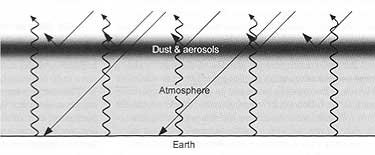
Figure 4. Effect of volcanic dust on cooling of continental interiors. Straight lines are solar radiation, partly reflected back to space by dust and aerosols. Wavy lines are infrared radiation. The result is the inverse of the greenhouse event.
The ice age was caused by the climatic backwash of the Genesis Inundation.55 As a result of this great tectonic and volcanic upheaval, the stratosphere would have held great quantities of dust and aerosols immediately afterward the Inundation. Copious mail service-Flood volcanism would take reinforced the polluted stratosphere. Thus sunlight would take been partially reflected back to space from the volcanic products trapped in the stratosphere (Figure four). Less sunlight would accept meant cooler land surfaces, as was observed at various locations after the great volcanic eruption in ad 535.90 During the Flood, warm water from the 'fountains of the great deep' would have produced a warm mail-Inundation sea. Evaporation would be much greater at mid and loftier latitude than today due to the much warmer water. Copious evaporation close to the ice sheets would take been almost favourable for their rapid growth. After many centuries, once the oceans cooled, the ice sheets would have melted quickly. Many other aspects of the water ice historic period have been estimated, including the boilerplate thickness of the ice sheets, the length of the ice age, the number of ice ages, etc.55
Mammoth population explosion
Was there enough time for the mammoth population to increase to millions by the end of the postal service-Flood ice historic period? We can estimate the mammoth growth afterward the Flood by examining the reproductive habits of African elephants, a good analogue.91
The elephant reproductive charge per unit can vary significantly.92 Elephants do not accomplish sexual maturity until age 10 to 23.93 They live fifty to lx years. Eltringham94 states that more often than not, elephants produce a dogie at intervals of four to five years with twins ane.35 % of the time. Still, some take suggested that elephants can give birth every ii to three years, and there is a case of a zoo elephant giving birth two years and five months after its first nascence.95 The reproductive rate is especially enhanced in a favourable environment as when the population is low or the animals are being hunted regularly.92,96,97,98,99 In that location are no natural enemies for a mature elephant, except man,100 just calves are subject to predation.So, mammoths take the potential to increase rapidly following the Flood.
Based on doubling rates of x years101 and 25 years91 observed in Africa, at that place would be (assuming platonic circumstances with no predation or dogie mortality) 2.i million mammoths in 300 years or viii million mammoths in 550 years,102 respectively. In other words, there should be no problem for the population of woolly mammoths to reach many millions toward the terminate of the ice historic period some 600 years after the Overflowing.
The post-Flood rapid ice age would have had milder winters and cooler summers with trivial if any permafrost, mainly because the Arctic and North Pacific Oceans were warm, and ice-free55 It would not accept been the formidable landscape observed today or deduced from uniformitarian ice age expectations. Since the lowlands of Beringia were not glaciated, some other uniformitarian conundrum, Beringia would take been a favourable environment for many mammals.
Extinction of the mammoths at end of ice historic period
Of all the questions related to the mammoths, their extinction has been the most perplexing. Information technology was not but mammoths that became extinct at the end of the ice age, only also many other big animals. Why? We will first discuss their extinction in Siberia and and so the extinction of the mammoths and other water ice age mammals on whole continents or worldwide.
Were woolly mammoths quick-frozen in Siberia?
The existence of carcasses with identifiable tummy remains and well-preserved basic and tusks has suggested a 'quick-freeze' to many. This has been reinforced by the research of the Birds Eye Frozen Foods Company, which calculated a sudden fall to beneath -100°C based on rut conduction.103
Creationist quick-freeze advocates32,69 postulate that the quick-freeze was directly related to the Alluvion. However, as previously discussed in the section 'Did Siberian mammoths die in the Flood?' the evidence is potent that the Siberian mammoths are buried in post-Overflowing sediments associated with the ice historic period. All the arguments presented in that section, such as the mammoths of Beringia existence part of one Northern Hemisphere ice age beast, would apply against the quick-freeze hypothesis.
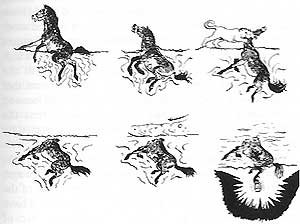
Figure five. Headless horse in mine shaft indicates that some fourth dimension elapsed betwixt when the brute was trapped and final burying. Guthrie's cartoon145 speculates how the equus caballus was trapped in a bog with its head and neck exposed, which was subsequently eaten by a carnivore. The sixth picture illustrates how the legs of the horse protruded into the mine shaft. One of its hind legs was used to adhere cables and hang lanterns. The equus caballus could have just equally hands been mired in wind-diddled dust as in a bog. Indeed, the horse was institute in loam, sandy loam and sand with a steppe-similar sporo-pollen circuitous,146 typical of wind-blown deposits and vegetation.
At that place are other arguments against the quick-freeze hypothesis.
1. The number of frozen carcasses, in spite of nether-reporting, is very small compared to the number of mammoth bones that underwent normal decay and are entombed in the permafrost.104,105
two. The carcasses are often partially rust-covered with fly pupae and display signs of scavenging,3,79,106,107 not expected during a quick-freeze.
three. The unique condition of several of the carcasses, such every bit the famished condition of Dima and the headless Selerikhan horse (Effigy 5),3,83 indicate some fourth dimension elapsed before final burying.
4. For some of the carcasses, death appears to have occurred at different times of the year.83,108 A quick-freeze during the Flood, particularly as advocated by some creationists, would take occurred in a single instant.
5. The characteristics of the permafrost that entombs the carcasses and bones, bear witness that it was not dumped quickly from to a higher place. It is hundred-to-one that water ice wedges would class during a quick drib of ice or hail from above.
How are the stomach contents explained?
The fact that the stomach contents were only partially decayed can exist explained satisfactorily by understanding the digestive physiology of the elephant, which was little known until the 1970s.109 From studying l freshly killed elephants, it was discovered that the main digestive process of elephants does not occur in the stomach, but after the food passes the stomach, particularly in the caecum and colon.109,110 Digestion is accomplished mainly past leaner and protozoa. Yet the researchers institute no protozoa, no fermentation and very petty hydrolysis of cellulose taking identify in the stomachs, although the stomach had a very acidic pH of about 2. This loftier acidity is expected to partially dethrone the breadbasket vegetation. It is articulate, therefore, that the stomach is mainly a storage expanse before digestion.111,112
Further evidence that the stomach contents should not necessarily decay completely upon expiry is provided by the preserved stomach contents of mastodons constitute in Northward America. Preserved vegetation from the gastrointestinal tracks of mastodons, which are by and large institute in onetime peat bogs, have occasionally been reported from the northeast U.s.a..113,114,115 Recently, the skeleton of a mastodon was discovered within peat on top of an water ice age terminate-moraine in Ohio.115 The remains yielded a discrete, cylindrical mass of plant material found in association with the articulated vertebrae and ribs.
Thus a quick chill is non needed to explain the partially preserved stomach contents of the mammoth carcasses.
The big chill and desiccation at the end of the ice historic period
About the terminate of the ice age, equally the ocean surface temperature cooled at mid and high latitude, and evaporation slowed, the equable water ice age climate would take changed to a drier, more continental climate with more seasonal extremes.116 Permafrost would begin developing in Beringia, and the substrate would become boggier in summer. Equally the climate became more continental during deglaciation, many animals in Siberia would tend to drift closer to the Arctic Ocean, where the waters were notwithstanding unfrozen and the climate would have been less continental. Notwithstanding, the changing climate finally caught upward with them and they ended upwardly cached in the permafrost that has continued to this twenty-four hour period.
Extinction of woolly mammoths in Siberia
With this climate change, there are a number of ways the mammoths and other animals could have died and become interred into the permafrost. Ane is by becoming trapped in bogs.73 I once thought the cold and wind, itself, could have simply killed them off,117 but it is probable that the mammoths could have endured much cold. I am sure some of the animals were trapped by the flooded rivers draining ice sheets and were cached in fluvial or lacustrine deposits.83,118 Upon further investigation, I now believe the vast majority of the mammoths and other mammals died and were interred into the permafrost by none of the above mechanisms. I believe the cloak-and-dagger to their demise and burying can be found in the type of sediment surrounding the woolly mammoths.
According to those who have studied these deposits, the vast majority of the animals are found in the 'yedomas' of Siberia22 and the 'muck' of Alaska. The yedomas, a Yukut term, are hills 10–xx grand, sometimes upwardly to 60 m, loftier, containing a large percentage of ground ice.119,120 The hills formed after a period of postal service-ice-age surficial permafrost melting. Muck is the name given by gold miners to the organic-rich material deposited above gold-begetting gravels in Alaska and the Yukon Territory.121 Vereshchagin122 states that the yedomas contain a bully abundance of mammal bones:
'The neat abundance of bones of big herbivores in the Yedoma is convincing evidence of the rich pasturage offered by this region during the Pleistocene ….'
What type of sediment makes up the yedomas and muck? In that location has been much controversy and a number of hypotheses on the origin of this sediment. There is now general agreement that the yedomas and muck are loess—a wind-diddled silt!121,123,124,125,126,127, Much data support the wind-blown origin of this sediment. The loess is also rich in footing ice and ice wedges. The ground ice formed by a segregation procedure in which layers and lenses of ice, sometimes clear and sometimes inter-mixed with sediment, developed within the silt.128,129,130, The loess is non thousands of anxiety deep in Siberia and Alaska, as some have thought, but is a relatively thin veneer that is widespread in Beringia.123,125,131,132, Some of the loess, especially in Alaska, has been reworked by downslope mass flow. Redeposition of the loess has broken and twisted the vegetation and disarticulated mammal bones, and this has inspired Velikovsky and others to suggest exotic catastrophes.
In the mail-Flood ice historic period model, strong wind would have characterised the large chill and dessication during deglaciation.133 In a dry out environment, this air current would have picked up and transported large quantities of silt and sand. Abundant wind-blown material is observed equally relic features of the water ice age in the Northern Hemisphere. Copious wind-blown dust even occurs in the ice age portion of the Greenland and Antarctica ice cores. It is known that mammoths and other mammals are entombed in loess in other areas.122,134,135,136, Thus, it seems likely that the mammoths in Beringia were mostly killed and buried by dust storms.
Grit storms of variable intensity likely blew from time to time for a few hundred years near the end of the water ice age. The animals could accept died from the directly issue of the dust or some other cause. Regardless, the dust would have cached their remains fairly rapidly. The characteristics of the pocket-sized number of carcasses that must accept been buried very speedily tin likely be explained by gigantic dust storms. From the Dust Bowl era in the midwest of the United States, it is known that a grit storm tin produce dust drifts several meters loftier, burying tractors and partially roofing buildings. It is possible that dust storms at the terminate of the water ice age would be so intense that they could comprehend and suffocate a woolly mammoth trying to survive the tempest. It may fifty-fifty be possible to suffocate a mammoth by the strong wind and blowing grit. The beast would have been buried quickly, since the animal would act similar a snowfall debate. Information technology is non inconceivable that a few of these animals would take been left in a continuing position, braced past the dust effectually them. The permafrost would then move upward after the loess was deposited and apace freeze the remains, thus bookkeeping for the rapid burial, which seems impossible any other way. The broken bones of the Beresovka mammoth could hands be explained by the shifting of ground ice and frozen sediment137— in other words a diagenetic, post-mortem outcome of shifting permafrost.138,139 Although some researchers lean toward such a diagenetic explanation, there was considerable blood near the wound of the foreleg of the Beresovka mammoth. Bleeding had occurred between the muscles and the fat and connective tissues.140
Mammoth fauna extinction elsewhere
The mammoths and many of the other animals went extinct either over the whole world or on continents they one time inhabited. This occurred at the cease of the ice age and probably into early mail-glacial time. The mystery has a reasonable solution within the post-Flood ice historic period model.141
The animals thrived during the water ice age because the temperatures were more equable with cool summers and milder winters. (Note that much of the continental state mass was never covered by ice sheets, even during the ice age.) The disharmonious associations of plants and animals all over the Northern Hemisphere during the ice age are prove of this equable climate. But, this equable climate concluded during deglaciation, and the climate became more continental with colder winters and warmer summers. The beingness of water ice sheets, the development of body of water ice and somewhen a cooler bounding main than today, would have resulted in less evaporation and a drier climate. The cold winters and dry climate would stress the animals all across the Northern Hemisphere. The larger mammals would have been especially susceptible to drought. Thus climate change likely was the chief cause of the terminate-of-the-ice‑age extinctions. The reason the large animals did not die out at the end of previous glaciations is considering there were no previous glaciations.142 Homo likely aided the extinction process by harvesting weakened animals.
Decision
Carcasses and bones of woolly mammoths in Siberia, Alaska, and the Yukon have been hard to explicate. The mammoth remains are abundant over the mid and high latitudes of the Northern Hemisphere, except in formerly glaciated areas. In that location are probably millions of them cached in the permafrost of Siberia alone. A wide diversity of other mammals, large and small, accompanied the mammoth. Many of these animals are grazers, implying that the paleoenvironment of Beringia was a grassland with a wide diversity of plants. This variety of plants and animals points to a longer growing season with milder winters and very little permafrost.
This paleoenvironment is contrary to what is observed in Beringia today, with its very common cold winters and boggy substrate in summertime. Scientists constrained past uniformitarian thinking seem to face conundrum after puzzler in regard to the life and death of the woolly mammoth in Beringia, as well as by the water ice historic period itself. A uniformitarian ice historic period climate would take been fifty-fifty colder even so. It is hard to conceive that the woolly mammoth and all the other animals could have lived in Siberia under these conditions. It is obvious the uniformitarian supposition does not apply. Thus, many hypotheses, both creationist and not-creationist, accept been proposed. Creationists take been divided on whether the woolly mammoth perished in the Flood or afterwards. A number of creationist hypotheses involve a quick freeze, because information technology was thought that the land of preservation of the carcasses with just half-decayed vegetation in their stomachs demanded it.
Reasonable explanations for all these mysteries are bachelor within the context of a unique mail service-Flood ice historic period. Astral catastrophies, pole shifts and other such exotic hypotheses are non needed. A quick freeze is also not necessary, and besides, there is much data confronting the hypothesis. In that location is strong evidence that the woolly mammoth died after the Overflowing during the ice historic period. There was plenty time for the population of the mammoths to accept grown to millions by the finish of the water ice historic period. Furthermore, this unique ice historic period was characterised by colder summers and warmer winters, resulting in a more favourable habitat for the animals in the non-glaciated lowlands of Beringia. The animals became extinct at the terminate of the ice age because the climate changed to a more continental climate, with colder winters and warmer summers, and drier weather condition. There is copious data against the hypothesis of a quick freeze. The state of preservation of the stomach contents are meliorate explained by the post-gastric digestive organisation of elephants in which the tum is mainly a holding pouch for vegetation.
The question of how the mammoths died in Beringia can exist answered by analysing the sediments surrounding the mammoths and other animals. They are mostly entombed in yedomas in Siberia and muck in Alaska. These are mostly loess and reworked loess. It is postulated that the animals were buried by dust storms, whether they met their demise straight past wind-blown silt or not. The carcasses and other perplexing data associated with the carcasses, such as death by suffocation, entombment while in a continuing position, and cleaved bones, can be explained past death during gigantic dust storms and mail-mortem shifting of the permafrost.
Acknowledgments
I thank Marking Russell, Kirk Toth, Dave Jolly, and Glen Wolfrom for providing hard-to-obtain literature and for providing information on the woolly mammoths. I also thank Tas Walker and others at AiG, Commonwealth of australia, for their valuable suggestions and Harold Coffin for reviewing the manuscript and suggesting a number of changes.
Source: https://answersingenesis.org/environmental-science/ice-age/the-extinction-of-the-woolly-mammoth-was-it-a-quick-freeze-9849/
Posted by: limonfordispreme.blogspot.com
0 Response to "Did Animals Really Freeze Instantly In Ice Age"
Post a Comment